- Many SMEs recognise the importance of digitalisation, but struggle to make meaningful progress. What are the biggest gaps you see today?
A common gap is the misconception that digitalisation is simply about adopting new tools. Many SMEs invest in platforms, but still find themselves relying on manual workarounds. For example, having to reconcile data across systems, or not having a clear, real-time view of their operations.
The real challenge lies in capabilities. Teams are often unsure how to interpret it or translate it into day-to-day decisions even when data is available. At the leadership level, a common challenge is deciding which use cases to prioritise, especially when time and resources are already stretched.
As a result, efforts remain fragmented rather than embedded across the organisation.
What’s needed is a structured way to build capabilities and apply them directly to real business challenges, not more tools. UOB FinLab works with Institutes of Higher Learning as part of UOB’s SkillsFuture Queen Bee appointment to curate programmes helping SMEs move from understanding digitalisation in theory to applying it in ways that deliver measurable outcomes.
2. You’ve worked with many SMEs across the region. Why is upskilling such a critical enabler of successful digital transformation?
Without the right skills in place, even good tools tend to be underutilised. Upskilling helps teams understand how to apply these tools in ways that actually improve operations or drive revenue.
Increasingly, this also applies to sustainability. Many SMEs are facing growing expectations around sustainability reporting and resource efficiency, but often lack the capabilities to translate these requirements into actionable steps. Digital tools – from data tracking to AI-driven insights – can play a key role in bridging this gap, but only if teams know how to use them effectively.
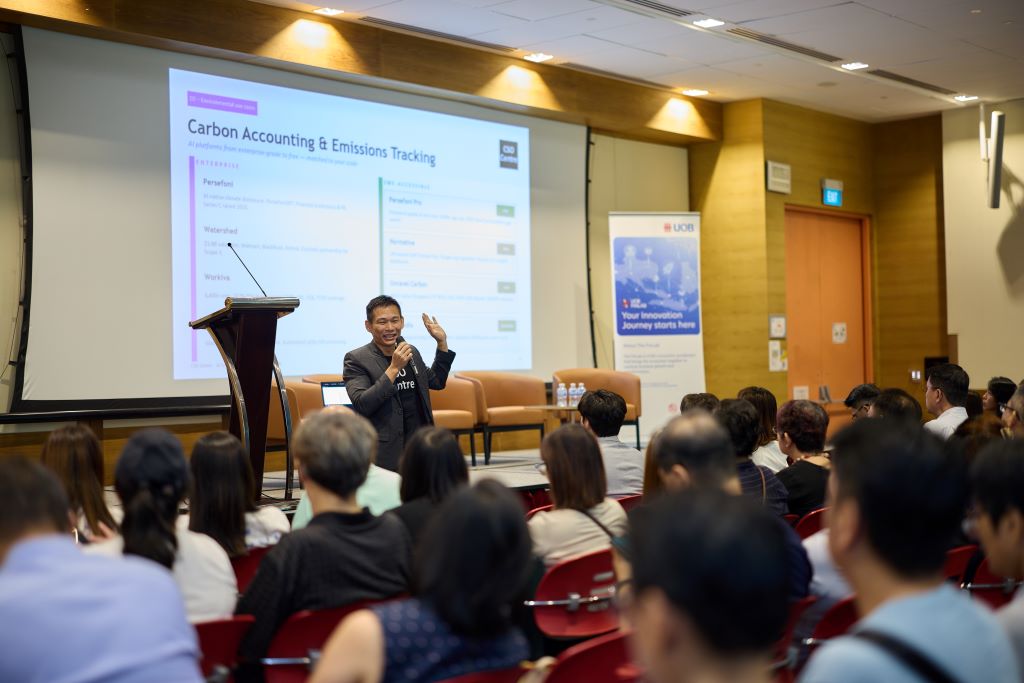
For instance, under the UOB FinLab SME Elevate Programme, participants in the AI for Sustainability Masterclass explored how AI can be applied to track emissions, optimise resource use, and support sustainability reporting in a more structured and efficient way. What this shows is that when learning is grounded in real use cases, businesses are better able to connect digitalisation with tangible outcomes.
When teams understand how to apply digital tools, data, or AI in their context, they are better equipped to make decisions and respond to change. Over time, this reduces the need to rely entirely on external vendors, as teams are able to evaluate, adapt and improve solutions independently.
We often see that SMEs who invest in building internal capabilities are able to test ideas more quickly and make decisions with greater confidence. They are more willing to experiment, iterate, and scale solutions because they have the confidence to do so.
At UOB FinLab, we focus on bridging learning with application. Foundational programmes such as “GenAI Content Creation” help leaders understand how AI can be applied in their marketing efforts, while more applied workshops like “Livestream Commerce & Real-Time Engagement” focus on translating these into specific business use cases, such as improving customer engagement or streamlining operations.
Ultimately, upskilling turns digital transformation from a one-off initiative into a continuous, sustainable capability within the organisation.
3. From your experience, what differentiates SMEs that are able to successfully transform from those that struggle?
One of the biggest differentiators is the mindset at the leadership level.
Across the SMEs I’ve worked with, those that succeed tend to view digitalisation as a continuous journey rather than a one-time project. They focus on a few high-impact areas, test small improvements, and refine based on what works rather than trying to overhaul everything at once.
They make deliberate decisions to build capability within their teams, and ensure that learning is applied to real business challenges rather than remaining theoretical. Rather than focusing purely on systems, they recognise that sustainable transformation comes from building capabilities across the organisation.
Another key factor is the ability to identify specific use cases where digitalisation or AI can deliver tangible outcomes – whether in improving operational efficiency, enhancing customer engagement, or enabling better decision-making.
Finally, they actively leverage the ecosystem around them. By tapping into partners, networks, and structured programmes, they are able to accelerate their transformation journey with the right guidance and support.
For example, I worked with an SME in the building maintenance and construction sector with over 200 employees that was facing rising manpower and operating costs, alongside increasing requirements for sustainability reporting. Rather than immediately investing in new systems, the company focused on building internal capabilities.
Through UOB FinLab, they learned to leverage SkillsFuture Enterprise Credit (SFEC) and course fee subsidies to upskill employees in sustainability, enabling them to better manage reporting requirements. At the same time, members of the senior management team enrolled in Generative AI productivity courses to reduce manual work, improve reporting efficiency, and enhance overall productivity.
This dual approach – upskilling both operational teams and leadership – allowed the business to address immediate challenges while building longer-term capabilities. Supported by complementary financial advisory and solutions, the company was able to take a more structured and sustainable approach to transformation.
Ultimately, the SMEs that succeed are those that combine the right mindset, clear priorities, and a willingness to invest in their people, while leveraging the ecosystem to move faster and with greater confidence.

4. Looking ahead, what capabilities should SMEs prioritise today to future-proof themselves?
First, the ability to identify parts of the business they can realistically digitalise, and which tools and skillsets are worth investing in. This does not mean becoming technical experts, but having a clear understanding of how technologies can be applied within the business and where it can create value.
Second, the ability to interpret available data and use it to inform day-to-day decisions, rather than relying purely on intuition. As businesses generate more data, the ability to interpret and act on insights becomes a key competitive advantage.
Finally, the ability to continuously test, adapt and refine processes as the business evolves. The pace of change today means organisations must be agile and respond to new developments.
We are seeing strong interest in programmes that support these capabilities, from foundational AI courses to more applied workshops on areas such as digital leadership and customer engagement. These initiatives help SMEs build both the technical understanding and strategic perspective needed to navigate an increasingly complex landscape.
Ultimately, the goal is to build organisations that are not just digitally enabled, but continuously evolving.
5. For a fun, personal touch: Describe and explain your job in one local dish.
I would describe my job as a bowl of laksa.
Laksa is an ecosystem, not a recipe.
The broth sets the direction, the spices add tension and depth, the noodles carry everything forward, and the toppings adapt to the person eating it – adjusting to taste, context, and appetite. No two bowls are ever exactly the same, yet everyone recognises it instantly. That’s what makes laksa powerful.
That mirrors what we do at UOB FinLab. Our role is to bring together SMEs, technology partners, industry experts, and learning opportunities, and connect them in a way that creates real, practical value. Every business we work with is at a different stage of its journey, just as each ingredient in laksa brings its own flavour and purpose.
Our job is to bring everything together – the right capabilities, the right tools, and the right support – so that SMEs can move forward with clarity, confidence, and momentum.