
UOB FinLab

AI Ready: How Singapore SMEs are turning anxiety into advantage

Featured Image For Ai Ready: How Singapore Smes Are Turning Anxiety Into Advantage

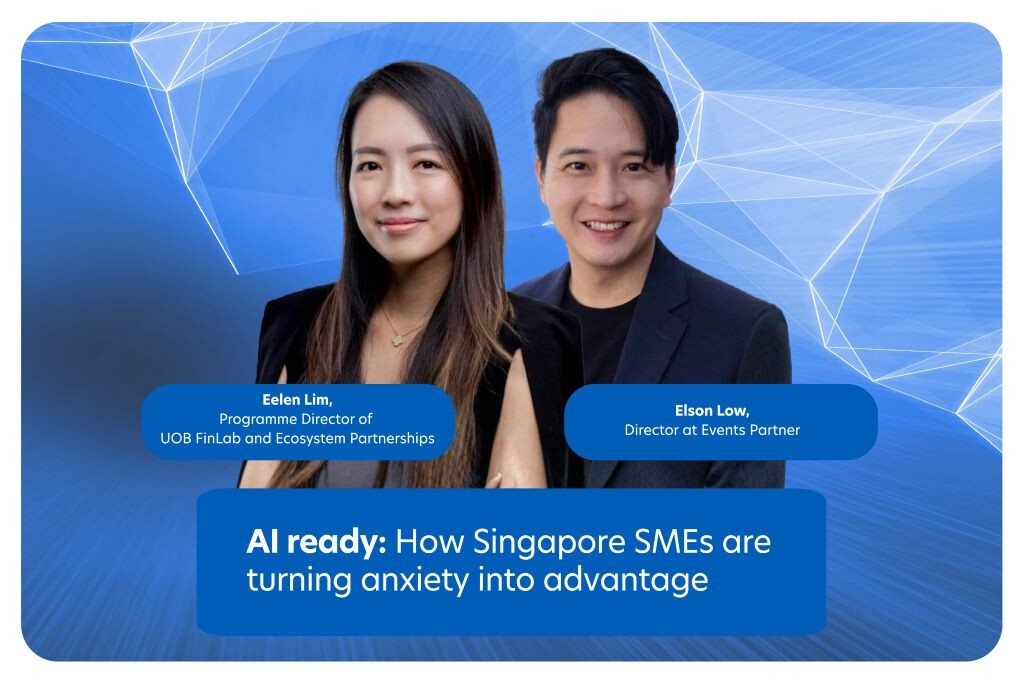
Listen to The Business Times  Podcast Series on “AI ready: How Singapore SMEs are turning anxiety into advantage”, published on 27th March 2026. Alternatively, read the summary below. 

For many small and medium enterprises (SMEs), artificial intelligence still feels more daunting than accessible. Concerns over cost, complexity and disruption often outweigh the perceived benefits, leaving business owners hesitant to act.

But that hesitation may now carry a greater risk than adoption itself.

In a recent The Business Times podcast episode, industry practitioners and ecosystem leaders discussed how Singapore SMEs are beginning to move past AI anxiety by focusing on practical, business‑led use cases rather than large‑scale transformation efforts. The conversation suggests that AI adoption is increasingly less about technology sophistication, and more about operational necessity.

The cost of waiting

AI may still be seen as futuristic by some businesses, but speakers in the episode emphasised that it is already a present‑day requirement for competitiveness. SMEs today face rising cost pressures, tight labour conditions and increasing customer expectations—leaving little room for inefficiency.

“The risk for SMEs is no longer adopting too early,” said Eelen Lim, Programme Director at UOB FinLab and Ecosystems. “The bigger risk now is waiting too long and allowing inefficiencies to compound.”

This urgency is reflected in broader market sentiment. The Business Outlook Study 2026 shows that 60% of businesses across ASEAN are looking to accelerate digital adoption, with 7 out of 10 of planning to expand their digital capabilities by at least 25%. At the same time, consumers are demanding faster response times and more personalised service, raising the bar for smaller firms competing with larger, better‑resourced players.

Start small, solve real problems

Events Partner, a Singapore‑based SME featured in the podcast, illustrates this shift. Like many service businesses, the company relied heavily on cold calling for business development—an approach that absorbed significant manpower with limited returns.

“We didn’t start with a grand AI roadmap,” said Elson Low, Director at Events Partner. “We started with one very clear problem that everyone felt—lead generation—and looked at how AI could help us do that better.”

Instead of pursuing broad digitalisation, the firm applied AI to improve lead qualification and outreach. By narrowing the scope to a single operational pain point, the business reduced both cost and complexity, while achieving measurable outcomes within a short timeframe.

Just as importantly, the early success helped shift internal mindsets. “Once the team saw that this actually worked, the fear dropped,” Elson added. “They became more open to exploring what else we could improve.”

Building capability, not teams

SMEs do not need to hire specialised AI teams to get started. In many cases, existing employees already possess the business knowledge needed to identify viable use cases.

“What SMEs really need is not an AI department, but AI muscle,” Eelen explained. “That comes from helping teams understand what AI can and cannot do, and giving them the confidence to experiment responsibly.”

Rather than relying heavily on external vendors, embedding AI capability within teams allows solutions to remain grounded in real workflows and business context. Programmes such as the UOB FinLab AI Ready Programme, aim to address this gap by offering structured guidance, practical workshops and exposure to real‑world use cases across the region.

Through the programme, SMEs can assess their AI readiness via the AI Readiness Index (AIRI) Survey, establish their baseline, and identify practical next steps.

Sustaining momentum

Speakers cautioned that early success does not guarantee long‑term impact.

“Getting one use case right is only the beginning,” Eelen highlighted that SMEs need a clear way to move from experimentation to repeatable impact. Implementing a single AI solution, while important, can quickly lose momentum without clear ownership and continued prioritisation.

UOB FinLab’s “Awareness–Action–Acceleration” approach, reflects a structured attempt to guide SMEs beyond experimentation towards repeatable impact to isolated wins into longer‑term capability building.

Redefining readiness

Ultimately, “AI‑readiness” is not defined by advanced systems or large investments, but by mindset. SMEs that are willing to question existing processes, start small and learn quickly are better positioned to extract value from AI.

For Singapore SMEs navigating an increasingly constrained operating environment, the path from anxiety to advantage appears less about transformation—and more about taking the first practical step.

AI Ready: How Singapore SMEs are turning anxiety into advantage

Featured Image For Ai Ready: How Singapore Smes Are Turning Anxiety Into Advantage

Online programme

Start Smart Programme

Designed for business owners to enhance their digital capabilities through practical learning, this programme takes businesses to the next level.

Online programme

Start Smart Programme

Designed for business owners to enhance their digital capabilities through practical learning, this programme takes businesses to the next level.

Don't miss out on the latest Digitalisation and Sustainability trends, insights and more!

Bridge ideas and innovation, subscribe to the FinLab Connect now!