
Darkness to Light: Illuminating the Leader Within Through Adaptive Leadership

When faced with uncertainty, some leaders take charge. Others turn to their teams for answers. But how do leaders know which approach a situation calls for?
There is no one-size-fits-all approach to leadership. What works in one situation may be less effective in another, requiring leaders to adapt their approach to the circumstances at hand. For small and medium-sized enterprises (SMEs), leadership decisions often have immediate consequences. A sudden operational disruption may require quick action, while introducing new processes could call for broader consultation and careful consideration of the risks involved.
These decisions are becoming increasingly important as businesses navigate changing priorities. According to the UOB Business Outlook Study 2026 (Singapore) H1, 39% of businesses are prioritising transformation, while 36% are focusing on efficiency amid ongoing uncertainty. For leaders, pursuing these priorities requires knowing when to drive change and when to draw on their teams’ expertise to make it work.
This situational agility and adaptability signals to employees that their voice matters beyond the mere execution of tasks. This transforms passive compliance into active trust and boosts morale in the team, especially during uncertainty. For SMEs, this flexibility can influence both the quality of decisions and the organisation’s capacity to respond to change.
Knowing When to Take Charge and When to Listen

Leadership approaches that have served a business well for years may need to evolve as the organisation grows.
As SMEs expand, business owners may find that decisions once made independently now require input from employees with different responsibilities and expertise. This can be particularly challenging when established ways of working have contributed to the business’ success, making it difficult to recognise when a different approach is needed.
There may not always be a clear answer, but leaders can consider a few practical questions: Do I have all the knowledge and understanding to address the issue at hand? Do I need to involve other team members? Is this an urgent issue that requires an immediate decision? How much employee buy-in will be needed to put it into practice?
The answers to these guiding questions can point towards different approaches. An urgent decision that can be easily reversed may leave more room to act quickly and adjust later. Where the consequences are harder to undo, seeking broader perspectives before committing may be more valuable.
Similarly, when the success of a change depends on how it works on the ground, involving employees closest to the process can reveal considerations that may otherwise be missed. These questions prompt strategic thinking and guide decision-making that reflects evolving needs, especially when faced with changing the status-quo or business transformation.
An example of this is Sigma Trading Transport. Founded in 1988, it is a logistics and transportation service provider that has had to adapt as the business evolved over two decades. Ashley, the founder’s daughter, saw the need to modernise its two-decade-old fleet management system and she took charge of the transformation project. She drew on maintenance data to make the case for a new fleet management system to the founding generation. After seeking feedback from employees’ on existing processes, she brought operational perspectives into the proposed changes to ensure that the system would work effectively for the team.
Her approach demonstrates how taking ownership of a decision and involving others need not be mutually exclusive. For SME leaders, the question is not simply about who makes the decision, but how to bring the right perspectives into the process while maintaining a clear direction for the business.
Knowing When to Change Course

Even well-informed decisions may encounter challenges once plans are put into practice. Leaders must remain attentive to these developments and actively consider whether their initial approach still meets the evolving needs of the business.
ISOTeam, Singapore’s leading building maintenance and estate upgrading maintenance specialist, encountered this during its digital transformation journey. After investing in project management and data-tracking platforms to boost productivity, the company found that the systems were underutilised because employees lacked the skills needed to use them effectively. Recognising the need to upskill their people, ISOTeam subsequently shifted its focus towards workforce development before undertaking major system overhauls.
The experience highlights adaptable leadership: knowing when to change course. While ISOTeam’s objective of improving productivity remained unchanged, the leadership understood that they needed to address employee upskilling to reap the full benefits of major system transformation.
Changing course does not mean entirely abandoning an earlier decision. It could mean adjusting the sequence, pace, or approach as new information emerges. Leaders who remain focused on the intended outcome, rather than becoming attached to how they originally planned to achieve it, are better placed to respond when faced with obstacles on the execution journey.
Leading confidently through uncertainty is not about defending every decision. It is about acting on the information available while remaining receptive to what the business learns along the way. Employees look to leadership during change and uncertainty. They notice how their leaders respond to concerns and provide direction, especially when they may not have all the answers. Leaders who communicate clearly, involve employees and topic experts, and are open to feedback help employees navigate uncertainty with greater confidence.
For SMEs, where leaders often work closely with their teams, these interactions can quickly shape workplace confidence and trust. That trust gives businesses something important when the next challenge arrives: a team that is more willing to speak up, adapt, and move forward together.
Illuminate the Leader Within
Facing challenges and obstacles as a leader can seem like dark days. But these are tests that illuminate true leaders by testing their leadership, decision-making and their instinct.
Leaders often fall back on familiar tendencies. Some may take a more directive approach when information is limited, while others may seek consensus even when circumstances call for a timely decision. Recognising these tendencies can help leaders understand when their instinctive response fits the situation and when they may need to adapt.
These instincts can be harder to recognise in familiar environments, where leaders can rely on established routines, roles and visual cues. Uncertain situations remove many of these reference points, pushing leaders to face the unknown and further hone their adaptability.
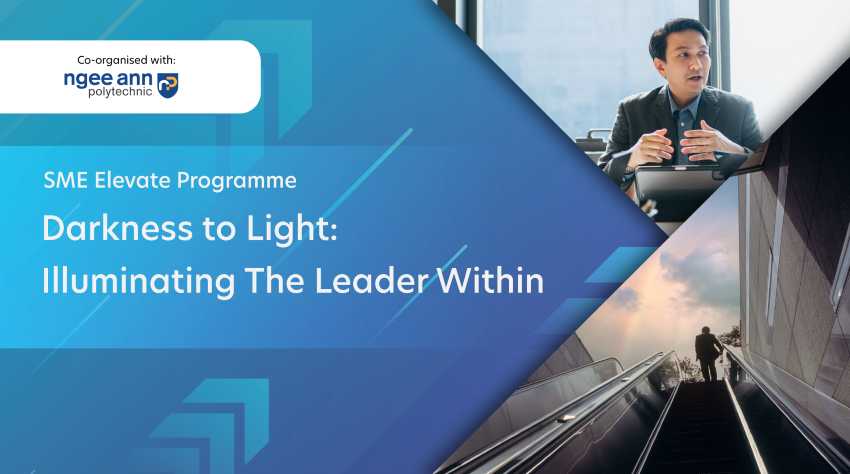
UOB FinLab’s upcoming Darkness to Light: Illuminating the Leader Within programme offers leaders, managers and business owners an opportunity to examine these behaviours through an immersive experience conducted in complete darkness.
Without visual cues, participants will navigate unfamiliar situations by relying on communication, emotional intelligence and collaboration. Do they instinctively take charge, seek direction from others, or place their trust in the team? And how might these responses influence the people they lead?
Through guided activities and reflection, participants will explore how their natural leadership tendencies influence decision-making, communication, and their ability to build trust and credibility within teams.
The programme also explores practical strategies for making decisions with limited information, strengthening leadership presence and fostering high-trust teams that can navigate change and ambiguity together.
Programme Details
| Programme | Darkness to Light: Illuminating the Leader Within |
|---|---|
| Date | 11 November 2026 |
| Time | 9:00 AM – 6:00 PM |
| Venue | Ngee Ann Polytechnic, 535 Clementi Road, Singapore 599489 |
Discover what your instincts reveal about your leadership style, and how greater self-awareness can help you lead with confidence when the way forward is unclear.
Register for the Darkness to Light: Illuminating the Leader Within Programme today.
Darkness to Light: Illuminating the Leader Within Through Adaptive Leadership