
From Pain Point to Production: Four Lessons from the AI Ready Changemakers Summit 2026

Artificial Intelligence (AI) adoption is no longer just a technical upgrade; it has become a central pillar of national strategy worldwide. Similarly in Singapore, digital transformation is no longer optional. Ministries are expanding dedicated digital transformation teams and driving initiatives like the National AI Strategy (NAIS) 2.0 under the direction of the National AI Council (NAIC). The government now treats AI as critical infrastructure while setting strict standards in cybersecurity, data security, and regulatory compliance to support the AI ecosystem.
During the recent UOB AI Ready Changemakers Summit, Senior Minister of State, Ministry of Digital Development and Information & Ministry of Health Tan Kiat How emphasised, “[The] businesses that benefit most from AI will not necessarily be the ones that adopt the most technology. They will be the ones that learn how to use it well and are able to adapt much faster to the changing technological landscape.” The fastest path to Return on Investment (ROI) lies in using AI to solve existing operational challenges rather than chasing standalone tools or rushing complex product overhauls.
Data from the UOB Business Outlook Study 2026 – Singapore Report (H2 2026) backs SMS Tan Kiat How’s comment. AI adoption among businesses surveyed in Singapore rose from 59% in H1 2026 to 83% in H2 2026. Businesses cite operational efficiency and process automation (53%), data-led insights (41%) and customer service enhancements (40%) as the leading benefits of AI. However, despite this progress, only 22% of businesses have reached advanced adoption, while 61% remain in the early stages.
To bridge this gap, companies can successfully adopt and scale AI solutions through four stages: identifying the problem, proving value through small-scale pilots, equipping employees to work alongside AI, and embedding proven solutions into core workflows.
This is the journey that the UOB FinLab AI Ready Programme is designed to support. By bringing together practical guidance, prototyping opportunities, ecosystem expertise, peer learning and financing pathways, the programme helps SMEs move from AI exploration to implementation and scale.
Stage 1: Identify the Friction, Not the Tool
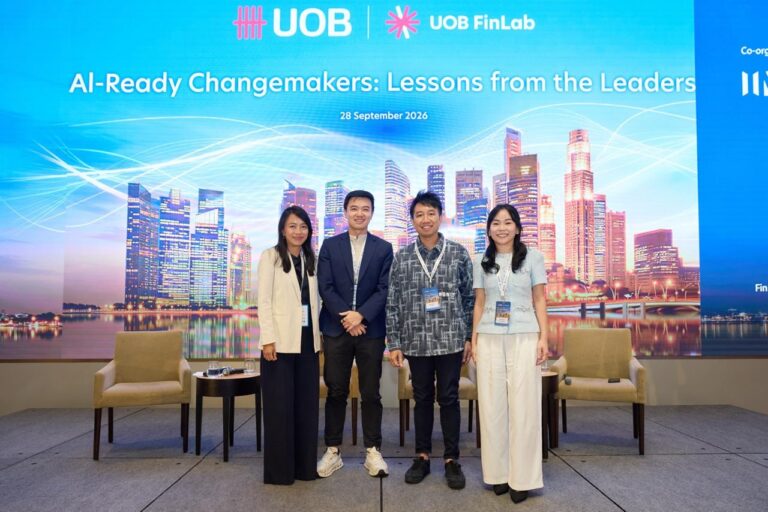
A successful AI adoption starts with identifying operational realities, not software hype. Rushing to purchase AI tools without identifying which problem needs fixing can quickly backfire. Instead of helping, it may waste leadership’s time, risk leaking sensitive data and pull employees away from the work that actually keeps the business running.
Through the UOB FinLab AI Ready Programme, Krislite, a Singapore-based lighting solutions company, identified tender management as a key operational challenge following a series of discovery sessions. The process involved reviewing tender specifications, identifying suitable products, sourcing suppliers and preparing submissions. To address these inefficiencies, the company has developed a Tender AI Agent through UOB FinLab’s Proof-of-Concept Programme. The solution aims to reduce tender preparation time by up to 30%, while capturing institutional knowledge from experienced employees to improve consistency in tender submissions.
Having access to a trusted ecosystem with established partners like UOB FinLab, and AI Singapore will help companies to better understand their companies and identify workflow issues that can be better improved with AI solutions. This discovery process helps management manage the risks.
Stage 2: Test Small Before You Scale
With core operational friction mapped, SMEs should resist launching enterprise-wide deployments of AI solutions. Full-scale implementation could heighten financial risk, drain internal bandwidth and trigger organisational resistance. Successful AI adoption hinges on executing low-risk proof-of-concept (PoC) trials and scaling up as necessary to validate the model performance, build internal confidence, and generate measurable ROIs before committing to long-term investment and transformation.
Events Partner, a local events furniture rental company, avoided a costly, front-to-back sales overhaul. Instead, the firm ran a targeted Proof-of-Concept (PoC) focused solely on automating top-of-funnel lead qualification before proceeding to invest in a multi-agent sales workflow to support the closing of leads. This controlled experiment more than doubled monthly targeted outreach — from 30–40 to 80–100 prospects. Validating ROI on a single friction point built internal confidence and eliminated fear, paving the way for multi-agent sales workflows. Access to a trusted ecosystem allowed them to share practical experiences, helping them avoid unnecessary investments and reduce the learning curve.
Connecting businesses with vetted technology solution providers, hands-on advisory, and a guided AI validation track ensures companies test model safety, accuracy, and team integration before committing capital or shifting precious employee bandwidth, protecting themselves from multi-year vendor lock-in, team burnout, and the crippling organisational failure that follows a failed enterprise rollout.
Stage 3: Empower People, Not Just Processes
Once a PoC proves its value, the barrier to enterprise-wide adoption shifts from technology validation to change management and workflow integration. Expanding software licensing without employee enablement often results in shelfware, fragmented data silos and employee pushback. For the scaling phase to be sustainable, one must embed the technology directly into existing core operations under a “generate and validate” framework – where AI automates heavy data processing while human experts retain oversight and final authority.
Singapore-based security systems company Secure Vision moved beyond using AI for individual productivity to helping employees develop skills they could apply across the business. Through the UOB SME Elevate Programme, which offers guidance from dedicated Skills Managers and training tailored to business needs, Secure Vision strengthened its ability to identify opportunities for AI and automation in its daily operations. The company put its learning into practice during a condominium upgrading project, streamlining resident communications, registration, data collection and follow-ups. By reducing routine administrative work, Secure Vision aimed to give employees more time to serve customers, address technical issues and handle matters requiring human judgement.
Beyond initial pilot support, the AI Ready 2.0 Programme also connects SMEs with specialised capacity-building partners, relevant solution providers, and talent transformation resources. For the scaling phase to be sustainable, businesses must embed AI into existing operations while ensuring employees are equipped to oversee its outputs, exercise judgement and retain final authority over critical decisions.
Stage 4: Embedding AI Across Core Workflows
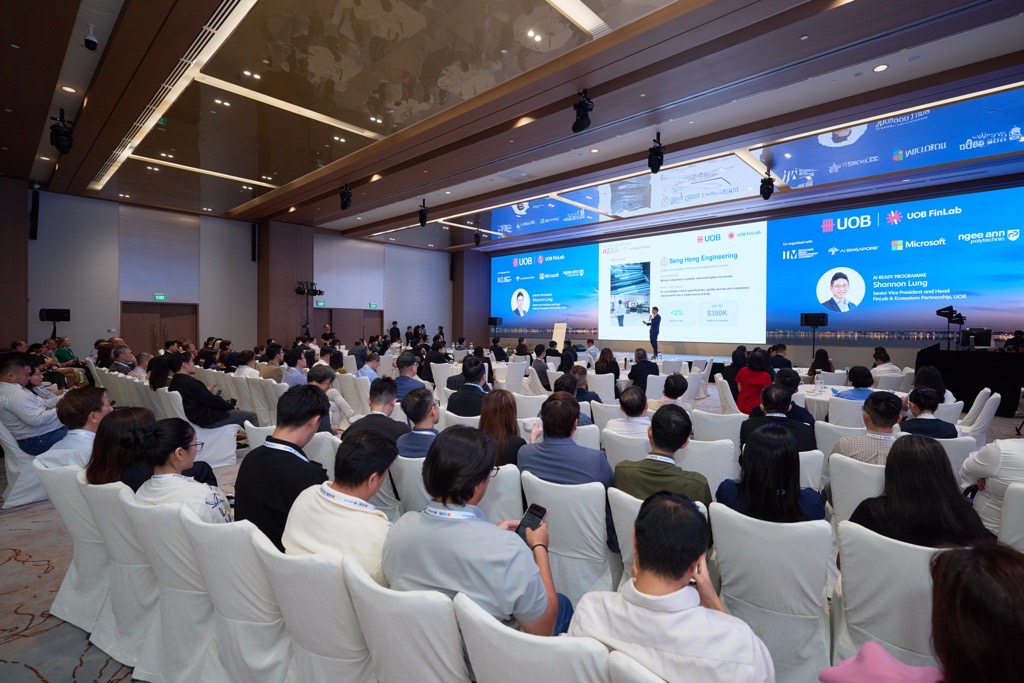
Scaling AI across an enterprise without governance risks data security breaches and initiative fatigue, among other issues. SME leaders often treat AI adoption as a one-time setup rather than an ongoing operational discipline. Long-term success requires clear performance frameworks, real-time ROI monitoring and clear data governance to ensure the tools remain accurate, secure and financially aligned with core business objectives over time.
Singapore-based critical fasteners manufacturer and distributor, Seng Heng Engineering Pte Ltd, progressed from AI exploration to operational implementation through UOB FinLab’s AI Ready Programme. The company developed an AI solution to automate quality assurance documentation review and compliance validation, integrating AI into processes critical to maintaining operational standards.
The solution is expected to reduce review time from hours to minutes, lower documentation error rates to below 2%, improve compliance traceability and deliver up to S$350,000 in cost savings over three years. By applying AI to quality assurance and compliance workflows, Seng Heng demonstrates how SMEs can move beyond standalone AI tools towards more systematic integration into core operations.
Just as Seng Heng Engineering’s partnership with UOB FinLab helped the company to successfully embed AI into its workflows, SMEs can also do the same by exploring programmes that support SMEs through post-implementation reviews and access to peer learning networks. This continued ecosystem support ensures business leaders can assess new AI developments safely, strengthen implementation, and consistently measure ROI as adoption expands.
From AI Ready to Future Ready
The decisive competitive advantage in an AI-driven economy will not belong to the SMEs with the largest technology budgets, but to those that can identify where AI creates value, build workforce confidence, test responsibly and embed successful solutions into the way the business operates.
Moving from curiosity to sustained enterprise impact requires moving methodically through the four stages: isolating operational friction, running low-risk Proofs-of-Concept, upskilling existing staff to keep humans in the loop, and embedding validated tools into core operational infrastructure. Supported by structured ecosystem initiatives like the UOB FinLab AI Ready Programme, this framework ensures technology remains an economic multiplier rather than an unmanaged cost centre.
The mandate for business leaders today is simple: stop waiting for an all-encompassing tech strategy. Start with value, bring your people along and build towards scale. AI becomes transformative not when a business adopts the most tools, but when it uses technology to create better ways of working and lasting business impact.In a market where speed and margin discipline dictate survival, the businesses that master this incremental discipline will out-execute and out-scale the competition
From Pain Point to Production: Four Lessons from the AI Ready Changemakers Summit 2026