
Resilient Leadership: Driving Growth in an Unpredictable World

For a small and medium-sized enterprise (SME) leader, the hardest decisions rarely arrive when all the facts are available. Should the business invest or conserve cash? Expand or consolidate? Move quickly on a new opportunity or wait for greater certainty? Each choice affects the organisation’s people, resources and ability to grow.
The challenge is not to decide faster. It is to understand what deserves urgency, what requires patience, and how to bring the team forward when there is no obvious answer.
The pressure behind these decisions is becoming more immediate. The UOB Business Outlook Study 2026 (Singapore) H1 found that rising operational costs affect one in three businesses. For SME leaders, this adds another layer of complexity to decisions around investment, hiring, pricing, and expansion. Pursuing growth can quickly stretch the people and resources needed to sustain it before they are even ready for it.
This is where resilient leadership becomes critical. For SMEs, four areas are especially important: leadership capabilities, decision-making and execution, trust and connections, and financial resilience. Strengthening these areas can help businesses respond to change without losing sight of long-term growth.
Building Leadership Capabilities for Growth

Many SME leaders build their businesses through personal drive, decisiveness, and deep involvement in daily operations. These qualities are valuable when resources are limited, and decisions need to be made quickly.
However, the capabilities needed to start a business are not always the same as those required to sustain and grow it.
A founder accustomed to approving every decision may eventually become a bottleneck. Confidence in a familiar approach may discourage alternatives. The determination to solve every problem personally may leave employees waiting for instructions rather than taking ownership.
Leadership capability is built by reducing this dependence. Clear decision rights, purposeful delegation, and managers who can exercise judgement allow the business to move without every issue returning to the founder.
Self-awareness helps leaders recognise that distinction. Where do decisions repeatedly stall? Which responsibilities could others take on? Are employees offering different views, or simply agreeing with the person in charge?
Recognising these patterns can help SME owners see where their own approach may be holding the business back. By developing leadership across the team and giving others greater responsibility, they can reduce bottlenecks and spend more time focusing on strategy, customers and growth.
Making Decisions and Following Through

Recognising personal blind spots is only part of the task. Leaders must also determine how much information is sufficient to act and how much risk the business can carry.
Not every decision needs the same level of certainty. When Events Partner wanted to improve its manpower-intensive approach to lead generation, it did not try to overhaul the business at once. The Singapore SME made a conscious choice to weigh up the pros and cons when implementing AI technology to improve lead qualification and outreach. The decision allowed the company to reduce the cost and complexity involved, while allowing the team to see whether the approach worked before exploring other areas for improvement.
For leaders, starting small can be useful when a decision can be tested and adjusted along the way. Other choices, such as signing a multi-year lease for a second outlet, hiring ahead of demand, or entering a new market, are harder to reverse. These may require more scrutiny before committing time and money.
Clear objectives, spending limits, and review points can also help leaders decide whether to continue, adjust, or stop an initiative. The aim is not to eliminate uncertainty, but to understand how much the business is committing before it knows whether something will work.
When things do not go to plan, leaders also need to learn and adapt. Urban Origins, for example, initially struggled to gain buy-in from local food producers who were unfamiliar with the business and its mission. The team continued engaging them and gradually built their trust, while founder Suzanna Tang turned to UOB FinLab programmes to gain knowledge and resources as the business grew.
Setbacks can provide useful lessons when leaders take the time to understand what is not working, adjust their approach, and apply those lessons to the next decision.
This learning should extend beyond the leader. Employees need the capabilities to implement decisions, clarity about their responsibilities, and opportunities to exercise judgement themselves. A team that can identify problems and act within clear boundaries strengthens the organisation’s ability to execute.
Building Trust and Stronger Connections
Changing course can be a sign of sound judgement, particularly when new information emerges. But for employees to move with that change, they need to understand why it is happening.
Leaders who are open about what is known, what remains uncertain, and what could change help give teams that context. When employees understand the reasoning behind a decision and their role in carrying it out, change becomes something they can take part in rather than simply being told to follow.
Trust also works in the other direction. Employees closest to customers and daily operations may be the first to notice weakening demand, process failures, or supplier issues. Leaders need to create enough trust for those concerns to be raised, particularly when they challenge an existing decision or assumption.
Listening does not mean avoiding difficult decisions or seeking agreement on everything. It means ensuring that decisions are informed by the people responsible for carrying them out. When employees know their input will be heard and leaders follow through on what they say, it becomes easier to maintain trust even when plans need to change.
Trust extends beyond the organisation too. Other SME leaders may have faced similar challenges, while mentors and industry partners can bring experience or expertise that the business does not have internally. These relationships give leaders more perspectives to draw on when deciding what to do next.
Strengthening Financial Resilience

The value of a business opportunity cannot be assessed separately from the organisation’s capacity to support it. Growth may look promising, but it can also put pressure on cash flow, staffing and day-to-day operations.
Strong sales do not always mean cash is readily available. Customers may pay later than expected, while suppliers, employees and other expenses still need to be paid on time. For a growing SME, that gap can quickly put pressure on working capital.
Cash-flow visibility and access to liquidity help leaders understand what the business can realistically support. Before taking on debt to open another outlet or hire ahead of demand, leaders should consider whether the investment can be delayed, introduced in stages, scaled down, or exited if growth takes longer than expected.
There is also a balance between protecting cash today and investing for tomorrow. Cutting back may ease short-term pressure, but holding off on essential skills or processes for too long can make future growth harder.
Financial resilience ultimately protects the ability to choose. When immediate cash pressures are under control, leaders are better placed to make decisions based on what the business needs for sustainable growth, rather than what short-term circumstances force them to do.
From Leadership Insight to Business Action
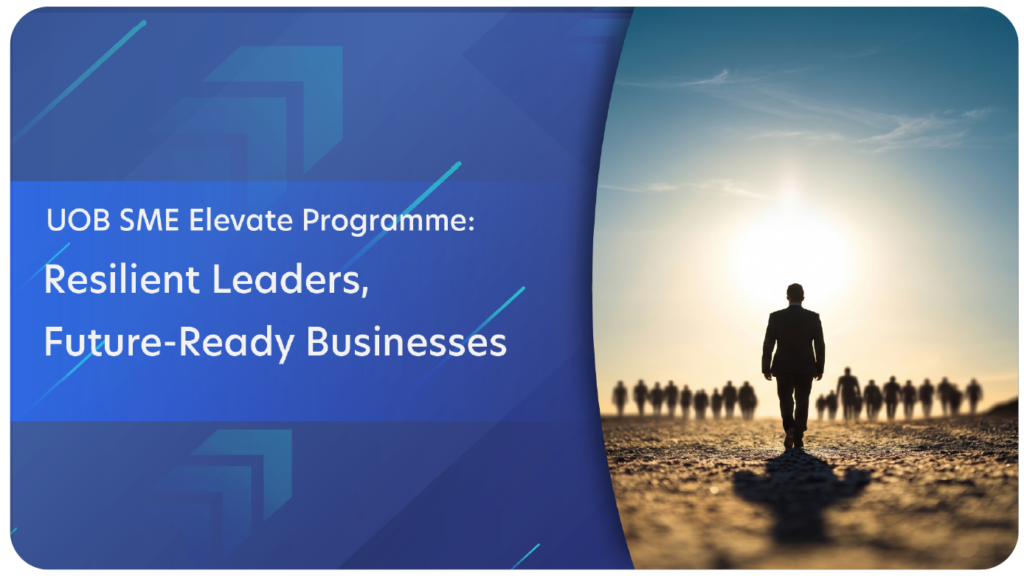
These leadership topics will be explored at UOB FinLab’s upcoming Resilient Leaders, Future-Ready Businesses, a half-day wellness masterclass held as part of UOB SkillsFuture Queen Bee’s SME Elevate Programme.
Rachel Ong, Founder and Chairwoman of ROHEI Learning & Consulting, will examine barriers to leadership effectiveness. A panel moderated by Shannon Lung, Head of FinLab and Ecosystem Partnerships at UOB, will bring together Yang Xi Ren of Xel Consulting, Jamie Koh of Brass Lion Distillery and Goh Shu Yi of The Strengths Co. to discuss decisions under pressure, resilient teams and lessons from setbacks.
Peter Phan of Ngee Ann Polytechnic and Sim Kah Yong of Dialogue in the Dark Singapore will explore trust as a leadership advantage. Paul Kan, Country Head of SME Banking (Emerging Enterprise) at UOB, will address financial discipline, cash flow management and business continuity. Networking will provide opportunities to exchange experiences and build connections with fellow SME leaders.
Certainty may not arrive before the next important decision. Leadership development helps ensure that, when that moment comes, an SME has more to draw on than the instincts of the person at the helm.
Register now to strengthen your leadership capabilities and prepare your business for what comes next.
Resilient Leadership: Driving Growth in an Unpredictable World